Participating

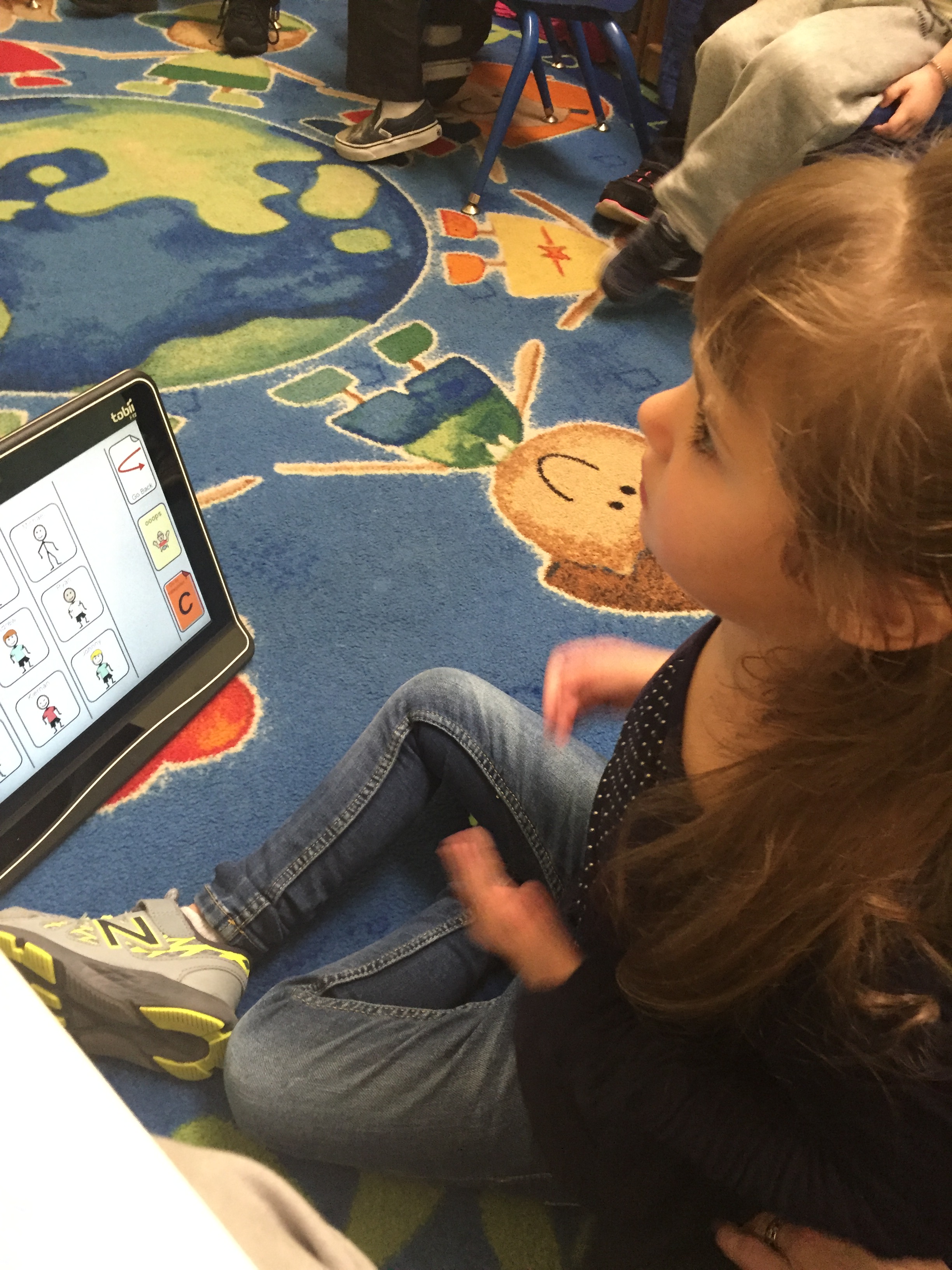
Lily has had a fantastic few weeks at school.  She’s been independently using the Tobii at circle time to interact with the teachers and students.  She’s been identifying letters and numbers (through the Tobii).  She’s also been speaking independently… saying things like ‘hurry up!’ and ‘hi!’ and ‘Woo back!’.  The last phrase is a horseback-riding term her hippotherapists try to get her to say when she is asked to stop the horse.  Oh, and Lily has been doing great with using a utencil too to self-feed.  Woot-woot!

Keep it up kid!

Using the Tobii to participate during circle time!

Using the Tobii to participate during circle time!


The importance of genetic testing and Rett Syndrome…

I’ve recently been approached by two families who have concerns about their daughter’s development.  And both have asked me to share our journey to an accurate diagnosis.  If you remember, Lily was given two mis-diagnoses along this journey.  So I’ve decided to dedicate a post for families who are on a similar journey.  if you’re new to this site (you found me through middle of the night googling), please feel free to leave a message below and I’ll get back to you if you have any follow up questions.

Q: I am wondering if you could share with me a little more about your journey to an accurate diagnosis, as well as any providers or evaluations that you felt were significantly helpful?

To me, what was the MOST definite and defining moment for Lily was getting the genetic test results with the Rett diagnosis.  Here are the ‘steps’ it took to get there:

Autism diagnosis August 2012

Lily was talking and social and hitting all her milestones and then BAM.  At around 15-16 months, there was a major regression. The language went away, she became super aloof and disinterested and physically started demonstrating some delays as well.  She was initially diagnosed with autism at 18 months (both through Early Intervention and a private developmental pediatrician).

ESES Diagnosis November 2013

Once we started EI services (she was getting 20 hours of ABA, plus Speech, OT and PT), it became apparent that the autism label didn’t fit.  The words started to come back (and then go away – which is still happening).   She came out of her shell and was social and interested in the world around her again.  We then had a bunch of EEG’s done to try and figure out the underlying cause of her regressions and found out she had a rare form of epilepsy called ESES.  And we thought ‘aha! this is what is causing her regressions’.

Rett Syndrome Diagnosis January 2014

But while she was being treated for the ESES (using high doses of steroids that I had to inject into her leg every day which totally sucked for us both), we got the genetic results back (which we did to see if there was an underlying reason for the ESES).  Rett Syndrome was confirmed.  All her doctors (and she has many) were surprised with the results as she didn’t fit the ‘Rett girl’ profile.  She walked, she had some hand function and she wasn’t having seizures (though she does technically have epilepsy and has epileptic episodes which I’ve been told are NOT seizures).

Q: Who did you work with to get the Rett diagnosis?

The geneticist we worked with was Dr. Marion at Montefiore in the Bronx.  And what was especially great about being at Montefiore was that there is a Rett Clinic there (the only one in the tri-state area, led by Dr. Sasha Djukic) so we were already in the Montefiore system.  It also helped in terms of scheduling doctors appointments as the Rett clinic is open on Fridays and we now just go there once a year and see anywhere from 2 to 5 specialists in a day instead of going back and forth to the hospital to see all the different doctors.
Q: Where are you today?
A Rett diagnosis sucks.  But you learn to live with it.  And knowledge is most definitely power.  I know what I’m dealing with and I can better prepare myself and my child for the road ahead.  And by the way, it’s mostly a happy road we walk.
Q: Is she on a special diet?
Lily has been following the GAPS diet for the past two+ years (though she has pizza on Fridays at school) and is on the growth charts which I believe is because of the healthy foods and supplements she takes (many girls with Rett start to fall off the growth charts by the age of two).  She sees a nutritionist regularly.
Q: What types of therapies does she receive?
She goes to a private special needs preschool where she receives numerous therapies, and has an augmentive communication/speech generating device that she navigates with her eyes (think Stephen Hawkins).  It is called a Tobii.  Actually she has two Tobii’s – one at home (which we own and were able to procure through the EI program) and one at school (which took a year of advocating through the DOE CPSE program).
Here are the services she receives through the DOE, on a weekly basis:
At school:
  • 1:1 para professional for health and safety reasons (this is imperative: our girls cannot self defend)
  • 5×30 Speech Therapy
  • 4×30 Occupational Therapy
  • 4×30 Physical Therapy
At home (she has a ‘dual recommendation’, sometimes called an RSA, and is supposedly impossible to get through the DOE):
  • 6×60 SEIT (Special Education Itinerant Teacher)
  • 3×45 Speech
  • 3×45 OT
  • 1×45 PT
  • 4×60 Assistive technology services (so that the home speech therapist can program both Tobii’s and upload course curriculum to them so Lily can follow along in class and participate).
On the weekends she goes horseback riding through the GallopNYC program and is loving it.
Yes.  It is a lot of therapies.  And yes.  It was not an easy decision to put her in to all of these therapies.  But the proof is in the pudding:  My kid is thriving.
We live a mostly happy, and always busy life.  Yes.  It is possible.

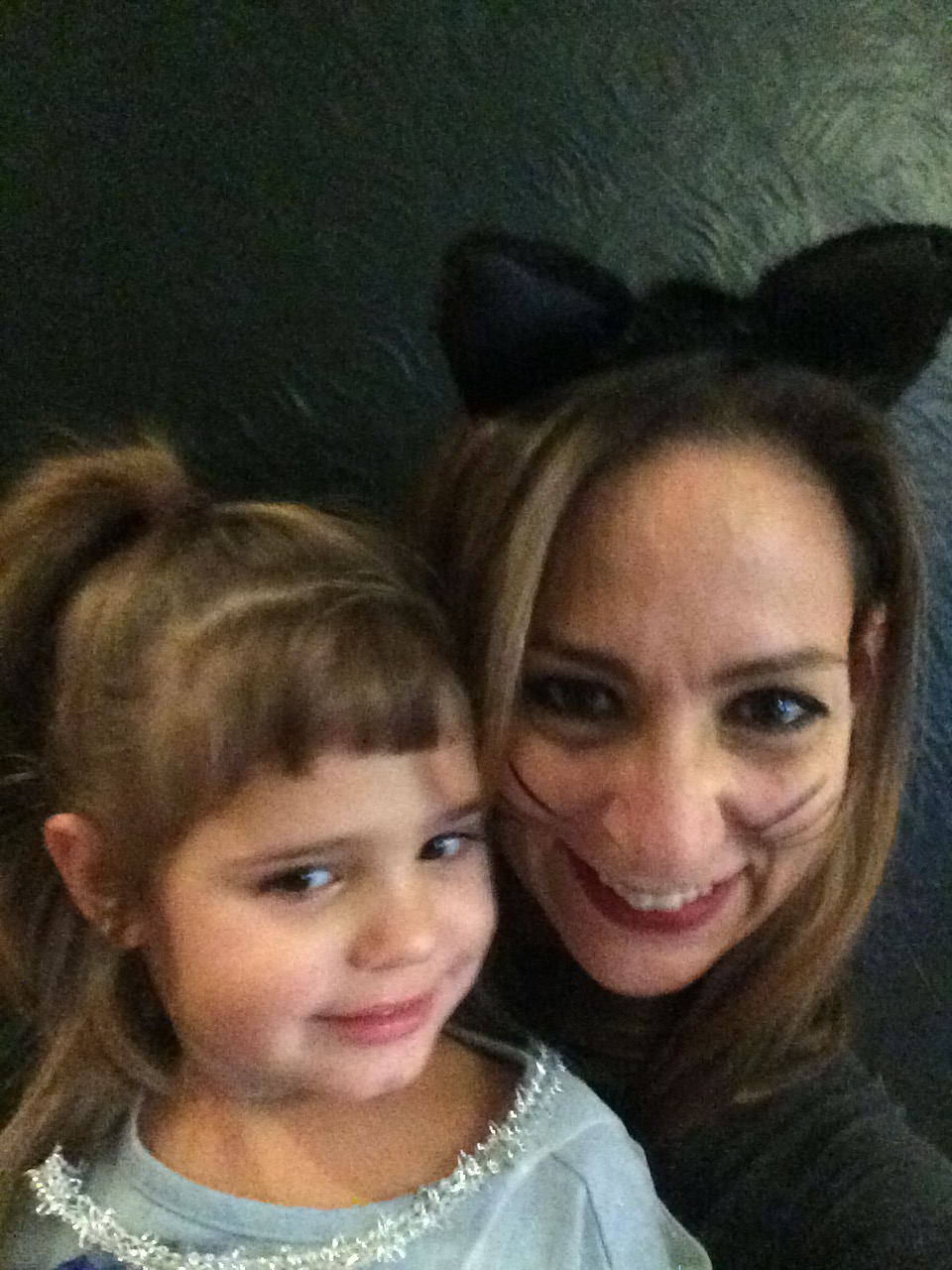
Happy Girls, Halloween 2015

Happy Girls, Halloween 2015

Join me on November 2nd in NYC to celebrate our amazing Rett sweeties

image In my spare time (!), I help raise awareness and funds for Rett Syndrome Research Trust (RSRT), an organization that is near and dear to my heart. Prior to last January, I had never heard of the organization, but since then, they’ve become a crucial part of my life, and my hope for my daughter’s future.

As you all know, Lily was diagnosed early last year with Rett Syndrome. It’s not a high-profile diagnosis, but it is a devastating one. Rett impacts 1 in 10,000 girls and women, and most are wheelchair-bound by the age of 2.

Lily is one of the lucky ones. This year alone, she has lost – and then regained – her ability to swallow and use her hands purposefully. She walks (or runs!), has some hand function, and doesn’t need a feeding tube. She’s also making HUGE progress in her communication skills, with the use of specialized eye gaze technology.  I want to thank you for taking part in this journey with me.  Your support through this blog – both near and far, is indescribable.

I also don’t know what I would do without her army of therapists and doctors (at last count there were over 25). They have become like family to me, as have my friends at RSRT.

Sleeping peacefully during an EEG yesterday at the hospital.

Sleeping peacefully during an EEG yesterday at the hospital.

This organization has made remarkable progress in advancing research on Rett Syndrome. A few years ago, approaches attacking Rett at its genetic root were not possible. Today there is scientific evidence that gene therapy could offer an effective way to treat – or even reverse – the disorder. RSRT is spearheading an ambitious gene therapy project to make this possibility a reality.

But we need your help to continue this scientific momentum and to support more research projects. I hope you can join me this year at the RSRT’s 7th annual Reverse Rett fundraiser to celebrate our girls and help work towards making their fugures even brighter.

Please click here for details. I hope to see you there!  If you can’t make it, please consider making a donation – any amount, small or large, helps us get one step closer to a cure.

Thank you.

Sleep no more

As many of you know, this is the title of a popular, yet confusing and somewhat annoying show here in New York City.  It’s also the title for my life right now, which is somewhat confusing and annoying.

I know this sleeplessness is just a phase.  But it’s going on way too long.  And it’s different from her previous episodes.  Lily’s inability to fall asleep lately is tinged heavily with bouts of hysterical laughter.  Yes, it’s cute.  And a lot of the time I do laugh alongside her because her giggles are infectious.  For those of you who are fortunate enough to have heard her belly laugh, you know what I’m taking about.  But at midnight?  When it’s been going on (and off) for a few hours?  It’s not so funny.  It’s downright alarming.  And annoying.  There, I said it.

So I’ve been researching the laughter.  And it turns out, it’s one of the many facets of Rett syndrome.  Something neurological is going on in this kid’s mind.  And it is likely linked to the increased ‘Rett episodes’ she’s been having.  Yup.  In August, and into September there have been more than a few times that she’s woken up, shortly after falling asleep, with scary shaking and convulsing spells: she’s fully aware of what’s going on and is looking at me with terror in her eyes begging me to make it stop.  That, my friends, is Lily’s version of a Rett episode.  It’s not a full on seizure as she’s present during the convulsing. But something terrifying is going on in her brain.  And it’s terrifying the both of us.

These episodes have also impacted her physical function.  She’s become much more clumsy these past few weeks.

We are going back to the hospital in early October to see the Rett specialist. Likely the doctor’s recommendation will be to give Lily the trazadone she prescribed last year when her last awful sleepless period happened.

For now, I’m keeping an epileptic activity journal, noting all the times Lily has these ‘Rett episodes’.  And, in the meantime, I will do my best to keep laughing alongside my sweetie.

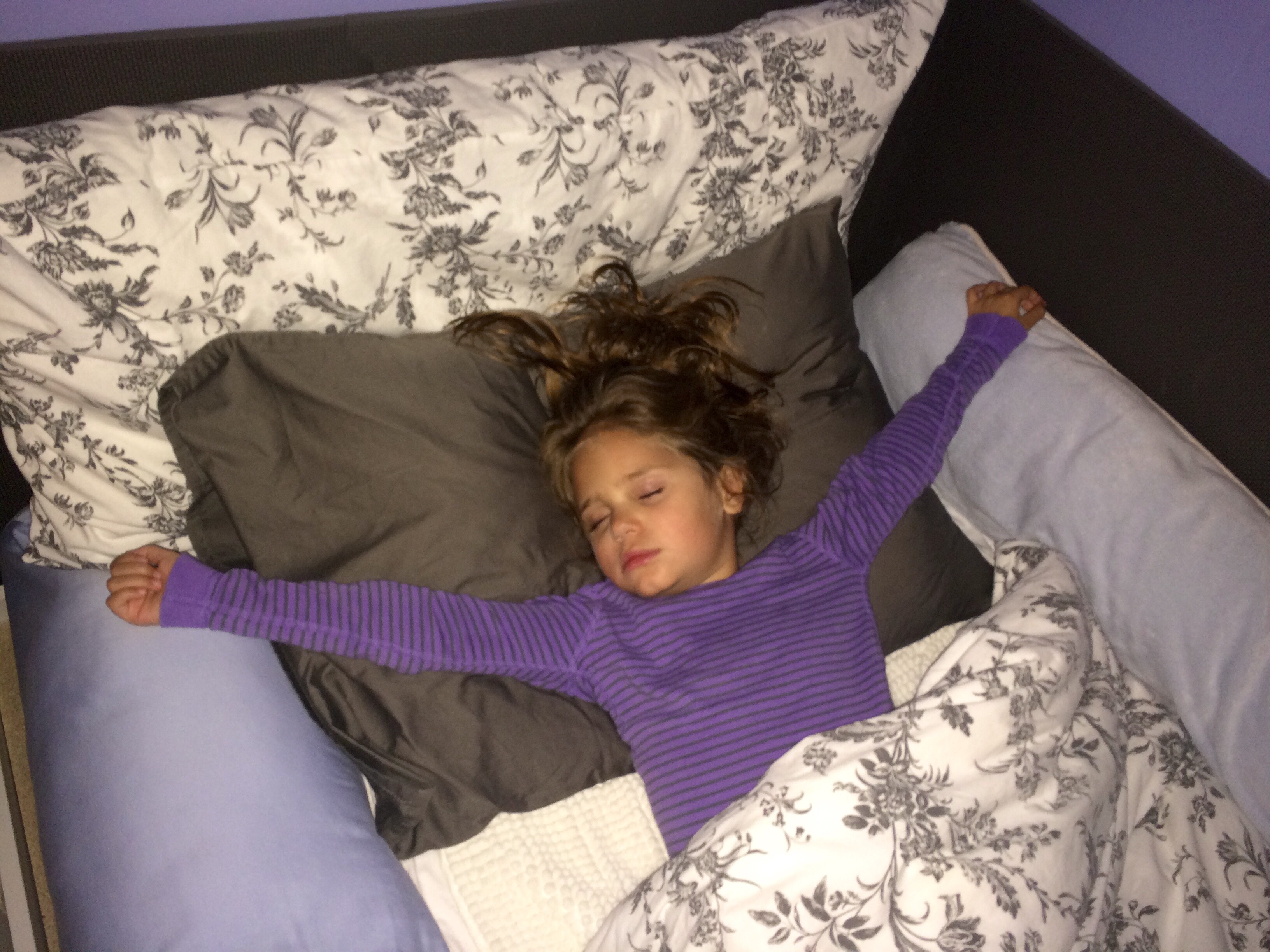
Lily's favorite sleeping position, 'the starfish'

Lily’s favorite sleeping position, ‘the starfish’.

Brave

image

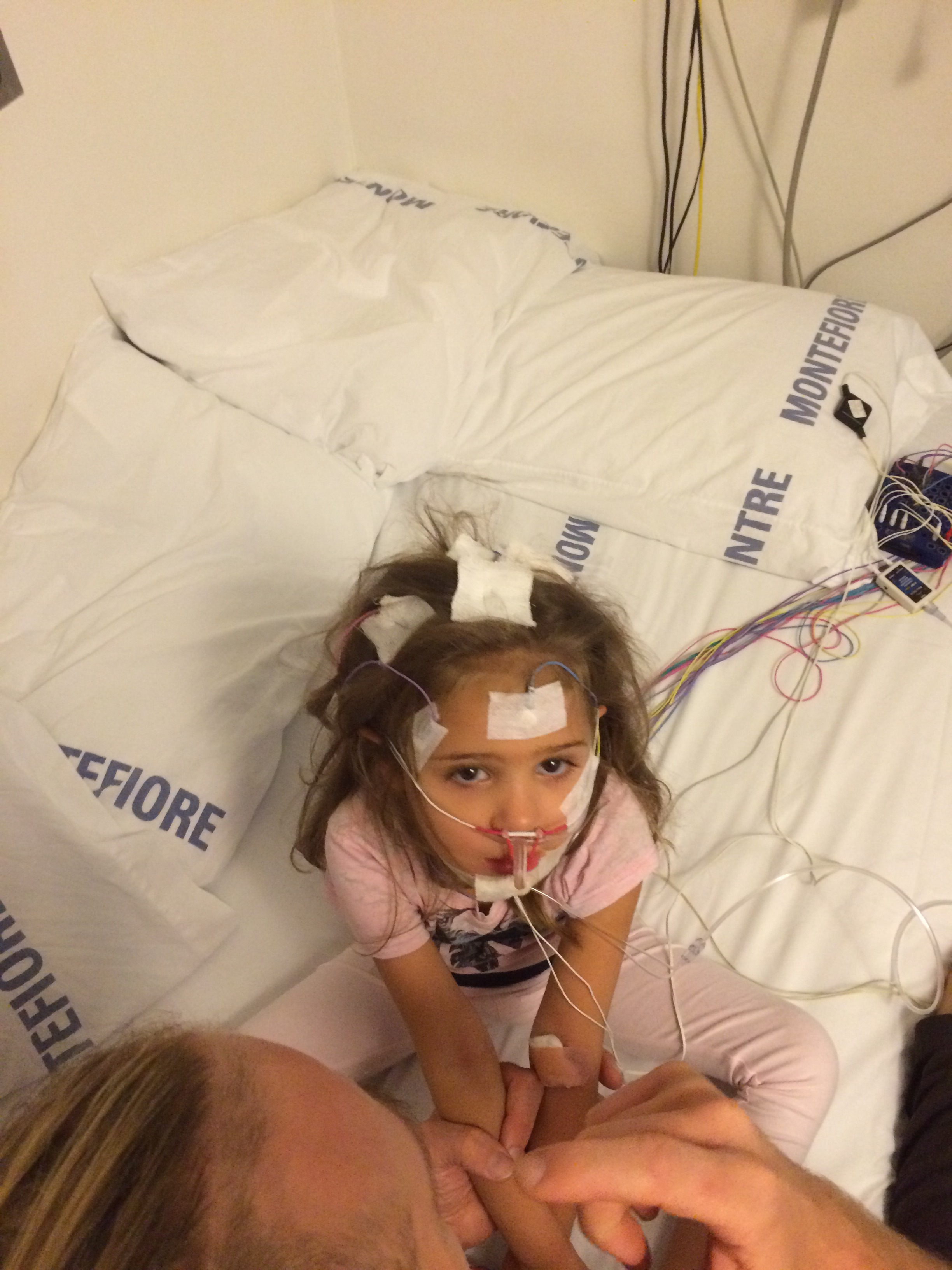
So here we are. Back at the hospital.

Lily is participating in a research study over the next 40 weeks on the impact of cholesterol on girls with Rett syndrome. The premise: lowering cholesterol levels in the brain (which are unusually high for girls with Rett) will improve gross motor function. Preliminary research is promising. (And if interested, I will email you the research paper).

I’m filled with tempered hope that all these tests my sweetie is, and will be, undertaking (along with 19 other Rett sweeties) will be worth the effort.

She is so brave. She is so strong. And I’m in awe at how she is taking all of these wires and pricks and prods in stride.

Our follow up appointments – thankfully – will be much less intrusive than this first visit.

I will be sure to keep you all updated on the progress.

C & L