A different kind of learning

Lily continues to impress both her home-based and school-based teachers and therapists (all 15 of them). This kid is super smart and silly, and most days she’s doing amazing things with communicating on the Tobii. Just the other day she had a conversation with her home teacher Denise to tell her that she was ‘angry’ and ‘greedy’ at school because she couldn’t play with the computer when she wanted to. And Denise explained that Lily can’t always get what she wants when she wants.

Oh, the perils of being an only child, raised in a single-parent home and having special needs on top of it. Creating boundaries and holding to them, reminding her that yelling is not nice, that sharing is important; I’m doing the best I can. But sometimes I’m not sure it’s enough.

She continues to be (mostly) sweet and loving and loud. I’m pretty sure that most parents of 5 year olds question their parenting skills and are driven mad by the noise and the insubordination. This brings me a strange sort of comfort. Makes me feel almost ‘normal’.

But I digress. Learning. It’s different for girls with Rett Syndrome. Some days this kid is on fire – engaged, communicative and creative. But there are those other days, the days when she didn’t get enough sleep or something else Rett related is going on, that she really struggles. I’m grateful that she, and I, have such a great support system who understands her ups and downs and are so creative in their approach.

image

Admiring her artwork – and her favorite ‘literary’ characters

image

Snapshot of her play/therapy room (PS someone got her first big-girl tooth!)

These photos make me so happy


I love that Lily’s classmates want to help her, play with her, work with her.  I said in my previous post that she causes a bit of a stir everywhere she goes, and school is no exception.

Walking down the halls, kids stop by to say hi to her. The teachers, therapists and aides all look forward to seeing this kids smile.  She is such a ray of sunshine to all she meets.


The importance of genetic testing and Rett Syndrome…

I’ve recently been approached by two families who have concerns about their daughter’s development.  And both have asked me to share our journey to an accurate diagnosis.  If you remember, Lily was given two mis-diagnoses along this journey.  So I’ve decided to dedicate a post for families who are on a similar journey.  if you’re new to this site (you found me through middle of the night googling), please feel free to leave a message below and I’ll get back to you if you have any follow up questions.

Q: I am wondering if you could share with me a little more about your journey to an accurate diagnosis, as well as any providers or evaluations that you felt were significantly helpful?

To me, what was the MOST definite and defining moment for Lily was getting the genetic test results with the Rett diagnosis.  Here are the ‘steps’ it took to get there:

Autism diagnosis August 2012

Lily was talking and social and hitting all her milestones and then BAM.  At around 15-16 months, there was a major regression. The language went away, she became super aloof and disinterested and physically started demonstrating some delays as well.  She was initially diagnosed with autism at 18 months (both through Early Intervention and a private developmental pediatrician).

ESES Diagnosis November 2013

Once we started EI services (she was getting 20 hours of ABA, plus Speech, OT and PT), it became apparent that the autism label didn’t fit.  The words started to come back (and then go away – which is still happening).   She came out of her shell and was social and interested in the world around her again.  We then had a bunch of EEG’s done to try and figure out the underlying cause of her regressions and found out she had a rare form of epilepsy called ESES.  And we thought ‘aha! this is what is causing her regressions’.

Rett Syndrome Diagnosis January 2014

But while she was being treated for the ESES (using high doses of steroids that I had to inject into her leg every day which totally sucked for us both), we got the genetic results back (which we did to see if there was an underlying reason for the ESES).  Rett Syndrome was confirmed.  All her doctors (and she has many) were surprised with the results as she didn’t fit the ‘Rett girl’ profile.  She walked, she had some hand function and she wasn’t having seizures (though she does technically have epilepsy and has epileptic episodes which I’ve been told are NOT seizures).

Q: Who did you work with to get the Rett diagnosis?

The geneticist we worked with was Dr. Marion at Montefiore in the Bronx.  And what was especially great about being at Montefiore was that there is a Rett Clinic there (the only one in the tri-state area, led by Dr. Sasha Djukic) so we were already in the Montefiore system.  It also helped in terms of scheduling doctors appointments as the Rett clinic is open on Fridays and we now just go there once a year and see anywhere from 2 to 5 specialists in a day instead of going back and forth to the hospital to see all the different doctors.
Q: Where are you today?
A Rett diagnosis sucks.  But you learn to live with it.  And knowledge is most definitely power.  I know what I’m dealing with and I can better prepare myself and my child for the road ahead.  And by the way, it’s mostly a happy road we walk.
Q: Is she on a special diet?
Lily has been following the GAPS diet for the past two+ years (though she has pizza on Fridays at school) and is on the growth charts which I believe is because of the healthy foods and supplements she takes (many girls with Rett start to fall off the growth charts by the age of two).  She sees a nutritionist regularly.
Q: What types of therapies does she receive?
She goes to a private special needs preschool where she receives numerous therapies, and has an augmentive communication/speech generating device that she navigates with her eyes (think Stephen Hawkins).  It is called a Tobii.  Actually she has two Tobii’s – one at home (which we own and were able to procure through the EI program) and one at school (which took a year of advocating through the DOE CPSE program).
Here are the services she receives through the DOE, on a weekly basis:
At school:
  • 1:1 para professional for health and safety reasons (this is imperative: our girls cannot self defend)
  • 5×30 Speech Therapy
  • 4×30 Occupational Therapy
  • 4×30 Physical Therapy
At home (she has a ‘dual recommendation’, sometimes called an RSA, and is supposedly impossible to get through the DOE):
  • 6×60 SEIT (Special Education Itinerant Teacher)
  • 3×45 Speech
  • 3×45 OT
  • 1×45 PT
  • 4×60 Assistive technology services (so that the home speech therapist can program both Tobii’s and upload course curriculum to them so Lily can follow along in class and participate).
On the weekends she goes horseback riding through the GallopNYC program and is loving it.
Yes.  It is a lot of therapies.  And yes.  It was not an easy decision to put her in to all of these therapies.  But the proof is in the pudding:  My kid is thriving.
We live a mostly happy, and always busy life.  Yes.  It is possible.
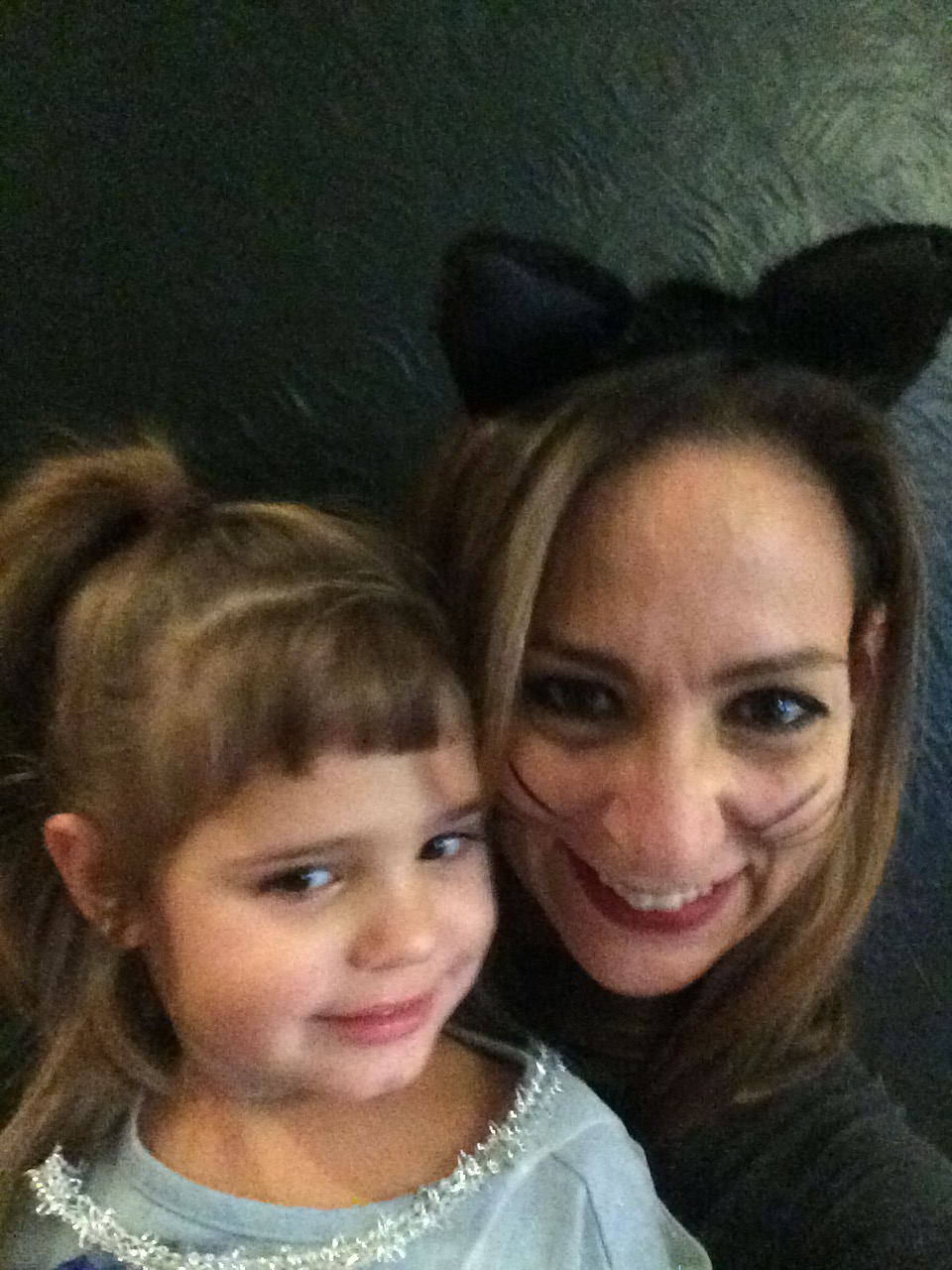
Happy Girls, Halloween 2015

Happy Girls, Halloween 2015

Join me on November 2nd in NYC to celebrate our amazing Rett sweeties

image In my spare time (!), I help raise awareness and funds for Rett Syndrome Research Trust (RSRT), an organization that is near and dear to my heart. Prior to last January, I had never heard of the organization, but since then, they’ve become a crucial part of my life, and my hope for my daughter’s future.

As you all know, Lily was diagnosed early last year with Rett Syndrome. It’s not a high-profile diagnosis, but it is a devastating one. Rett impacts 1 in 10,000 girls and women, and most are wheelchair-bound by the age of 2.

Lily is one of the lucky ones. This year alone, she has lost – and then regained – her ability to swallow and use her hands purposefully. She walks (or runs!), has some hand function, and doesn’t need a feeding tube. She’s also making HUGE progress in her communication skills, with the use of specialized eye gaze technology.  I want to thank you for taking part in this journey with me.  Your support through this blog – both near and far, is indescribable.

I also don’t know what I would do without her army of therapists and doctors (at last count there were over 25). They have become like family to me, as have my friends at RSRT.

Sleeping peacefully during an EEG yesterday at the hospital.

Sleeping peacefully during an EEG yesterday at the hospital.

This organization has made remarkable progress in advancing research on Rett Syndrome. A few years ago, approaches attacking Rett at its genetic root were not possible. Today there is scientific evidence that gene therapy could offer an effective way to treat – or even reverse – the disorder. RSRT is spearheading an ambitious gene therapy project to make this possibility a reality.

But we need your help to continue this scientific momentum and to support more research projects. I hope you can join me this year at the RSRT’s 7th annual Reverse Rett fundraiser to celebrate our girls and help work towards making their fugures even brighter.

Please click here for details. I hope to see you there!  If you can’t make it, please consider making a donation – any amount, small or large, helps us get one step closer to a cure.

Thank you.

La-la-land vs. reality

Below are two posts/articles written by mothers of special needs kids.  The first one is quite popular and somewhat annoying, if not clawingly uplifting.  The second post is one which, once I read, felt like it was something I would have written.  It resonated with me that much.


WELCOME TO HOLLAND

c1987 by Emily Perl Kingsley.

I am often asked to describe the experience of raising a child with a disability – to try to help people who have not shared that unique experience to understand it, to imagine how it would feel. It’s like this……

When you’re going to have a baby, it’s like planning a fabulous vacation trip – to Italy. You buy a bunch of guide books and make your wonderful plans. The Coliseum. The Michelangelo David. The gondolas in Venice. You may learn some handy phrases in Italian. It’s all very exciting.

After months of eager anticipation, the day finally arrives. You pack your bags and off you go. Several hours later, the plane lands. The stewardess comes in and says, “Welcome to Holland.”

“Holland?!?” you say. “What do you mean Holland?? I signed up for Italy! I’m supposed to be in Italy. All my life I’ve dreamed of going to Italy.”

But there’s been a change in the flight plan. They’ve landed in Holland and there you must stay.

The important thing is that they haven’t taken you to a horrible, disgusting, filthy place, full of pestilence, famine and disease. It’s just a different place.

So you must go out and buy new guide books. And you must learn a whole new language. And you will meet a whole new group of people you would never have met.

It’s just a different place. It’s slower-paced than Italy, less flashy than Italy. But after you’ve been there for a while and you catch your breath, you look around…. and you begin to notice that Holland has windmills….and Holland has tulips. Holland even has Rembrandts.

But everyone you know is busy coming and going from Italy… and they’re all bragging about what a wonderful time they had there. And for the rest of your life, you will say “Yes, that’s where I was supposed to go. That’s what I had planned.”

And the pain of that will never, ever, ever, ever go away… because the loss of that dream is a very very significant loss.

But… if you spend your life mourning the fact that you didn’t get to Italy, you may never be free to enjoy the very special, the very lovely things … about Holland.


HOLLAND SCHMOLLAND


c2008 By Laura Krueger Crawford
.

If you have a child with autism, which I do, and if you troll the
 Internet for information, which I have done, you will come across a certain inspirational analogy. It goes like this: Imagine that you are planning a
trip to Italy. You read all the latest travel books, you consult with
 friends about what to pack, and you develop an elaborate itinerary for your
glorious trip. The day arrives. You board the plane and settle in with your
in-flight magazine, dreaming of trattorias, gondola rides and gelato.

However, when the plane lands you discover, much to your surprise, you are 
not in Italy — you are in Holland. You are greatly dismayed at this abrupt
and unexpected change in plans. You rant and rave to the travel agency, but 
it does no good. You are stuck. After a while, you tire of fighting and
 begin to look at what Holland has to offer. You notice the beautiful tulips, 
the kindly people in wooden shoes, the French fries and mayonnaise, and you
 think, “This isn’t exactly what I planned, but it’s not so bad. It s just
 different.” Having a child with autism is supposed to be like this — not
 any worse than having a typical child — just different.

When I read that, my son was almost three, completely non-verbal and 
was hitting me over a hundred times a day. While I appreciated the intention
 of the story, I couldn’t help but think, Are they kidding? We are not in
some peaceful countryside dotted with windmills. We are in a country under
 siege — dodging bombs, trying to board overloaded helicopters, bribing
 officials — all the while thinking, What happened to our beautiful life?

That was 5 years ago. My son is now 8 and though we have come to 
accept that he will always have autism, we no longer feel like citizens of a
battle torn nation. WITH the help of countless dedicated therapists and 
teachers, biological interventions, and an enormously supportive family, my
son has become a fun-loving, affectionate boy with many endearing qualities
and skills. In the process we’ve created well our own country, with its 
own unique traditions and customs.
 It s not a war zone, but it s still not Holland. Let’s call it
 Schmolland.

In Schmolland, it is perfectly customary to lick walls, rub cold
 pieces of metal across your mouth and line up all your toys end to end. You
 can show affection by giving a “pointy chin.” A “pointy chin ” is when you 
act like you are going to hug someone and just when you are really close,
 you jam your chin into the other person s shoulder. For the person giving 
the “pointy chin” this feels really good, for the receiver not so much, but
 you get used to it. For citizens of Schmolland, it is quite normal to repeat
 lines from videos to express emotion. If you are sad, you can look downcast 
and say “Oh Pongo.” When mad or anxious, you might shout, “Snow can’t stop
 me!” or “Duchess, kittens, come on!” Sometimes, “And now our feature
 presentation” says it all.

In Schmolland, there’s not a lot to do, so our
 citizens find amusement wherever they can. Bouncing on the couch for hours,
 methodically pulling feathers out of down pillows, and laughing hysterically 
in bed at 4:00am, are all traditional Schmutch pastimes.

The hard part about living in our country is dealing with people from
 other countries. We try to assimilate ourselves and mimic their customs, but
 we aren’t always successful. It s perfectly understandable that an 
8-year-old boy from Schmolland would steal a train from a toddler at the
Thomas the Tank Engine Train Table at Barnes and Noble. But this is clearly 
not understandable or acceptable in other countries, and so we must drag our 
8 year old out of the store kicking and screaming while all the customers 
look on with stark, pitying stares. But we ignore these looks and focus on
the exit sign because we are a proud people.

Where we live, it is not
 surprising when an 8-year-old boy reaches for the fleshy part of a woman’s
 upper torso and says, Do we touch boodoo? We simply say, “No we don’t
 touch boodoo” and go on about our business. It’s a bit more startling in
 other countries, however, and can cause all sorts of cross-cultural
 misunderstandings. And, though most foreigners can get a drop of water on
 their pants and still carry on, this is intolerable to certain citizens in
 Schmolland who insist that the pants must come off no matter where they are,
 and regardless of whether another pair of pants are present.

Other families who are affected by autism are familiar and comforting
 to us, yet are still separate entities. Together we make up a federation of
 countries, kind of like Scandinavia. Like a person from Denmark talking with
 a person from Norway, (or in our case someone from Schmenmark talking with
 someone from Schmorway), we share enough similarities in our language and
 customs to understand each other, but conversations inevitably highlight the 
diversity of our traditions. Oh your child is a runner? Mine won’t go to
the bathroom without asking permission. “My child eats paper. Yesterday he
 ate a whole video box.” “My daughter only eats 4 foods, all of them white.”
”My son wants to blow on everyone.” “My son can’t stand to hear the word no.
 We can’t use any negatives at all in our house.” “We finally had to lock up
t he VCR because my son was obsessed with the rewind button.”

There is one thing we all agree on: we are a growing population.

10 years ago, 1 in 10,000 children had autism.

Today the rate is approximately 1 in 250.
(CS update: As of 2013, the rate became 1 in 55 children in the US.  No joke.)

Something is dreadfully wrong. Though the causes of the increase are
 still being hotly debated, a number of parents and professionals believe 
genetic pre-disposition has collided with too many environment insults –
toxins, chemicals, anti-biotics, vaccines — to create immunological chaos 
in the nervous systems of developing children. One medical journalist
speculated that these children are like the proverbial canary in the coal
mine here to alert us to the growing dangers in our environment. While this
 is certainly not a view shared by all in the autism community, it feels true 
to me.

I hope that researchers discover the magic bullet we all so
 desperately crave. And I will never stop investigating new treatments and 
therapies that might help my son. But more and more my priorities are 
shifting from what could be to what is. I look around at this country my
 family has created, with all its unique customs, and it feels like home. For 
us, any time spent “nation-building” is time well spent.