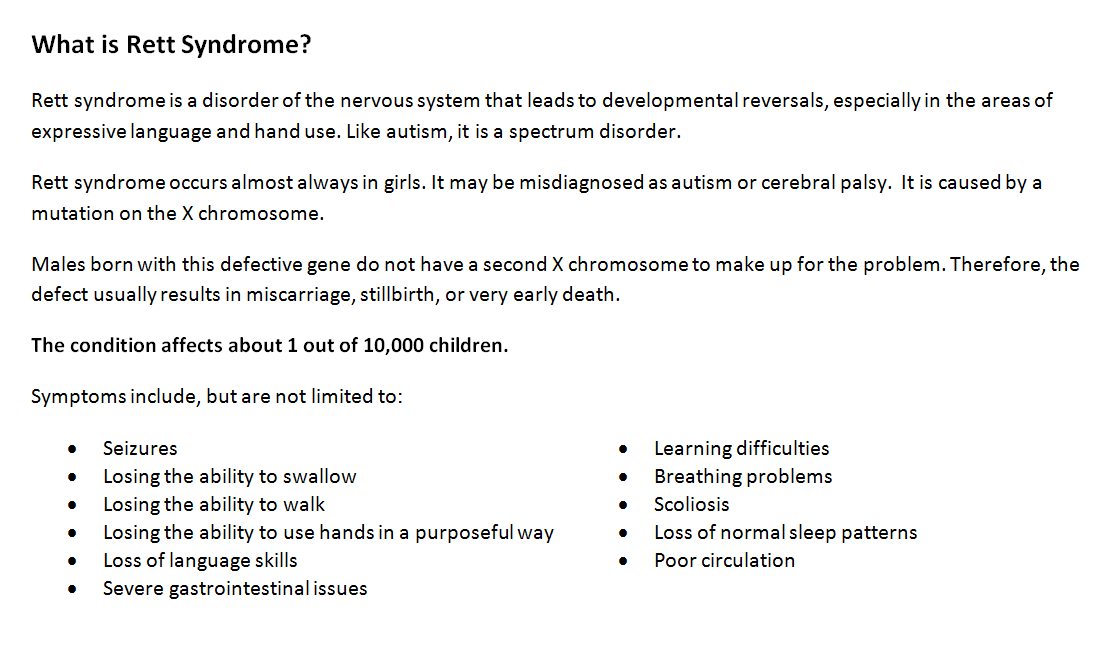
My daughter has Rett Syndrome

Up until today, there were only three people – in the past 16 months – who understood the gravity of these words when I spoke them: ‘my daughter has Rett Syndrome’.  Two were dear friends who happen to be doctors (though don’t assume that all doctors know what Rett is) and another had a close friend whose daughter has it.

Otherwise, I got a ‘um, wow. that sucks.’ or a ‘I don’t know what that is’ or – for the most part – I didn’t even get a response to an email when I was reaching out to someone to tell them.

I’m not upset at anyone about their lack of response.  Rett Syndrome?  Huh?  What is that?

But today these words ‘my daughter has Rett Syndrome’ brought a stranger to tears.

I was sitting there watching Lily at her Sunday morning horseback-riding class in Prospect Park, proud that she wasn’t having a complete meltdown on the horse (she’s been known to totally lose it on Cinnamon, the sweetest, oldest horse I have ever seen) when a woman sitting next to me asked if the stables were close to Prospect Park.  I told her that these stables are in Prospect Park!

I then asked her where she was from, as it was pretty obvious she wasn’t from Brooklyn. She’s from Long Island and came down to Brooklyn with her son to volunteer at GallopNYC through a program with JPMorgan, where she works.

We got to talking about corporate volunteer programs (which is something I know a lot about) and how grateful I was that she, and her teenage son, were here to volunteer to help kids and adults with disabilities ride horses.

Her son was one of the 5 people who were supporting Lily on Cinnamon that day.

So I began to tell her about Lily and I mentioned her Rett diagnosis.  She grabbed my knee, started crying and said, ‘I had no idea.’

She was shocked – she couldn’t believe how well Lily was doing.  This lovely woman then went on to tell me that she had a niece with Rett Syndrome.  Eventually, she told me that she signed up to volunteer at GallopNYC to honor the memory of her sweet niece who recently passed away at 5 years old due to complications from Rett Syndrome (it sounds like it this sweetie had a very severe case).

I think this woman walked away from our conversation with hope – that Rett Syndrome isn’t always the prison sentence it’s made out to be.  I walked away humbled, as always, by how well my kid is doing.

And it brought me to tears.
Spring Break, here we come!

Lily and I are heading down to Puerto Rico tomorrow.  5 days.  Sun.  Sand.  Swimming.  Just us two girls.  We can’t wait!

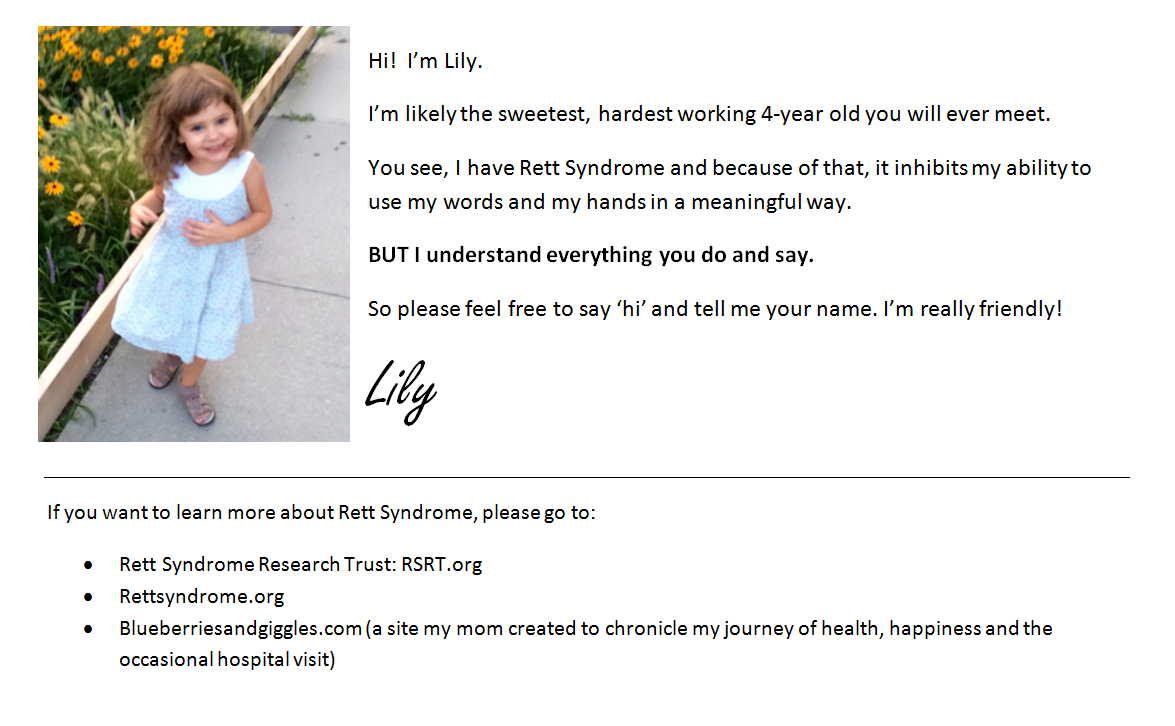
I put together this flyer to share with fellow travelers.  I realized the last time we flew that people were giving us looks because we’re different.  And I want them to know that just because we’re different, it doesn’t mean that we should get any less respect.  Actually, we should get more.  So this is my solution:

Front:

introBack:

CaptureWill let you know how it goes!

A different kind of report card

aI just received Lily’s progress report from her amazing after-school therapist Elaine, who is a speech language pathologist and Tobii/PODD expert.  Here are a few exerpts from the report:

  • Lily is a very sweet four-year-old girl who is learning to use an alternative means of communication due to her severe motor planning challenges.
  • Lily is not able to use speech or her hands as a functional means of communication.
  • Lily is using a high tech communication device (Tobii I-12 series device + eye gaze access) and a low tech communication book with partner assisted access (PODD communication books).
  • Lily is starting to develop her underlying communication skills (i.e. joint attention skills, alternating attention skills, eye contact, imitation skills both verbal and physical).
  • Lily continues to rely primarily on her caregivers anticipation of what she needs but she has been starting to imitate models of how she can request needs independently on her SGD.
  • Lily’s behaviors have significantly improved. She is much more regulated throughout sessions and does not rely on music as a form of comfort to soothe her when she is upset.
  • Lily is starting to participate more consistently during session activities and she can sit and attend for longer periods of time, 10-15 minutes without a break.
  • Through direct observation throughout our sessions Lily has demonstrated the ability to identify objects, discriminate objects from a field of up to 12 symbols per page, identify caregivers, greet “hi”, reject activities “no” , “finish”, request more of an activity, identify animals.
  • Lily has been able to initiate and carry out her responses to verbal directions much more consistently.
  • Lily has been able to follow the directions: “Stand”, “Sit”, “Open”, “look at me”, “let’s go to the kitchen”, “take the spoon” and “wave goodbye”.
  • Lily is currently able to follow verbal directions 3/10 times on average each session.
  • It is important to note that Lily’s difficulties with carrying out directions are due to motor planning difficulties not because she cannot understand what is being asked of her.

We still have a ways to go, but I’m confident that my kid is going to blow everyone away with her brilliance one day soon.

Love,

C and L


Planning for the future

A few weeks ago, I was interviewed by a NYTimes reporter about the steps I’ve taken to prepare for Lily’s financial future.  A few days later, a NYTimes photographer came over to take photos of me and L.

My ask of this reporter was this: I will share my story with you, but you have to help me raise awareness about Rett Syndrome.  She kept her promise.

And, if you click on the below link, you can see how upset Lily gets when her OT Katherine is working with her in one of the pictures.  My sweetie!

Please read and share this article with people you know who have children with special needs. Or just check it out to see pictures of the sweetest kiddo on the planet…

Look and you will hear

Communicating

“Know that people with Rett are communicating with you all of the time. It’s in when she looks at you, or doesn’t, it’s the length of her gaze, the shift of her gaze, in how wide her eyes get, in the eyebrows; it’s in the frequency or intensity of her stereotypie at any given moment, its in the moments she stops… Look and you will hear.” Denise R., Lily’s special ed at-home teacher.